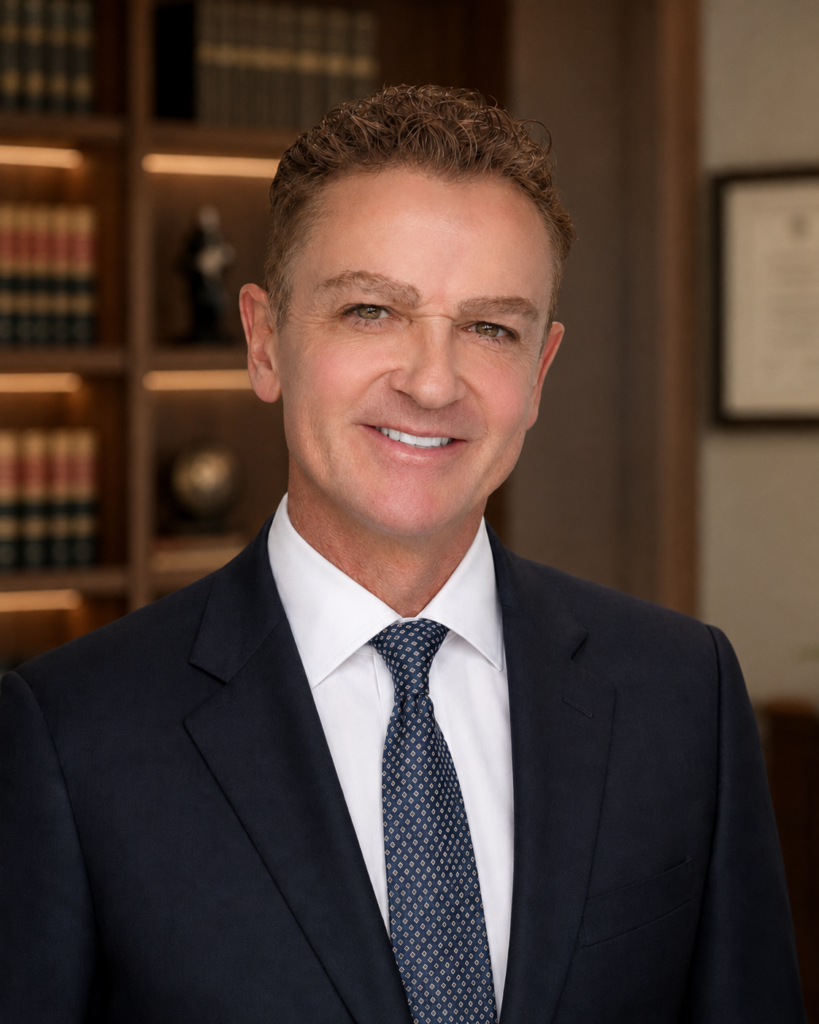
Michael Justice has practiced law in New Jersey since 1998. In 2002, he founded The Justice Law Firm. His work is concentrated in criminal defense, DWI, domestic violence, municipal court matters, expungements, and other cases in which a person’s freedom, reputation, livelihood, or future may be at stake.
The courtroom was not an accidental destination. From an early age, Michael was told that his instinct for argument, in its classical sense, his ability to identify the real issue in a disagreement, and his tendency to test a position through questioning belonged in a courtroom. What interested him was never disagreement for its own sake. It was the process of taking a complicated problem apart, finding the point that actually mattered, and determining whether a position could withstand scrutiny. That instinct eventually became a career.
Path to the Courtroom
Michael worked his way through college at jobs that included driving limousines and operating forklifts. He graduated from The College of New Jersey in 1994 with a Bachelor of Science in Criminal Justice, magna cum laude, and earned his law degree from Rutgers Law School in 1997. He was admitted to the New Jersey Bar and to practice before the United States District Court for the District of New Jersey.
Before founding The Justice Law Firm, Michael took an unexpected detour into corporate America, working in AT&T’s legal department as a lead negotiator on business-to-business transactions involving the Pacific Rim. The work demanded preparation, leverage analysis, patience, and the ability to distinguish between a stated position and the interest actually driving it. Over time, Michael developed a highly refined negotiation skill set that would later become an important part of his criminal practice. Corporate negotiations were ultimately about money. Criminal cases are about people. A prosecution can threaten someone’s liberty, career, family, driver’s license, reputation, and future. Aside from health, Michael believes there is very little in life more fundamental than personal freedom. That realization brought him back to the work he had always intended to do, and in 2002 he left the corporate world and founded The Justice Law Firm.
Independent by Design
Remaining a solo practitioner has been a deliberate choice. Michael values independence and wants responsibility for the decisions made in a case. When someone hires him, the matter is not passed to an associate or filtered through a case manager. He reviews the evidence, speaks with the client, develops the strategy, appears in court, and remains responsible for the case from beginning to end.
That independence also shapes the way he communicates. Clients often describe Michael as approachable, affable, and easy to talk to. He speaks plainly and without unnecessary formality or condescension. A person facing a criminal charge may be frightened, angry, embarrassed, confused, or carrying facts that are difficult to discuss. Effective representation begins with being able to have a candid conversation about all of it.
Michael does not believe confidence requires bravado. His style is quieter than that. The objective is not to look formidable. It is to understand the case better than the other side, know where the weaknesses are, and be prepared to act when an opportunity appears.
The Art of The Trial
Michael views the courtroom as a stage, and he does not regard that as a criticism. Shakespeare’s observation that “all the world’s a stage” has particular force in a place where the job is to persuade another human being. Michael believes facts matter, law matters, and preparation matters, but none of them presents itself.
Michael’s approach to trial advocacy is built around holding the listener’s attention. He believes an examination should have direction, an argument should have rhythm, and a presentation should be dynamic enough to make a judge or jury understand not only what happened, but why it matters. In Michael’s view, the best advocacy creates perspective. The listener should be able to see the event through the client’s eyes, understand the decisions that were made in the moment, and feel the human stakes that can disappear when a life is reduced to a police report, a laboratory result, or a statutory citation.
Michael does not view that as theater for theater’s sake. He views it as communication. A flat recital of facts delivered in a mechanical cadence may convey information, but in his view it leaves much of an advocate’s work undone. His approach to trial practice combines preparation and analysis with a presentation that keeps people listening and gives them a reason to care.
Independent Advocacy
Michael believes professional relationships with judges, prosecutors, and other lawyers matter, but professional relationships are not the same thing as seeking approval. A defense lawyer’s obligation is to the client, and a position that needs to be advanced should not be softened merely because doing so would make the courtroom more comfortable. If a ruling is wrong and there is a lawful basis to challenge it, it can be challenged, and if an argument needs to be made, it should be made plainly.
That approach becomes particularly important when a person unfamiliar with the legal system finds himself or herself being overwhelmed by it. Institutions have experience, procedure, authority, and momentum on their side. Michael has always been drawn to the role of becoming the obstacle that prevents that momentum from simply carrying a client along with it. There is satisfaction in forcing a powerful institution to stop, answer the question, produce the evidence, justify the procedure, and prove what it claims to be true.
Mitigating the Outcome
Michael believes effective representation also requires recognizing when a case cannot be made better by pretending the evidence is something it is not. Sometimes the evidence is strong. Sometimes a client has made mistakes that cannot be undone. Sometimes there is no clever argument that makes the problem disappear. In those cases, confidence means identifying what can still be improved and concentrating on the result that remains achievable.
Michael’s approach is to identify the best result actually available under the circumstances. That may require challenging a search, attacking the reliability of a test, finding a procedural defect, exposing an inconsistency, trying the case, appealing a ruling that should not stand, or negotiating a better resolution. The negotiation discipline Michael developed in AT&T’s legal department remains particularly useful here: understanding leverage, separating positions from real objectives, and recognizing where movement may be possible. Whatever the path, Michael’s focus is on finding it and pursuing it. A client should be able to tell him the worst of the story and know that the conversation will turn quickly toward what can still be done.
Outside the Courtroom
Michael doesn’t sit still. Travel has taken him throughout Europe, Asia, the Caribbean, parts of South America, Canada, Mexico, and across the United States. He is drawn to unfamiliar places in part because travel has a remarkable ability to dismantle assumptions. Mark Twain put it well in The Innocents Abroad: “Travel is fatal to prejudice, bigotry and narrow-mindedness.” Michael has repeatedly found the observation to be true. The stereotypes attached to a country or culture tend to become much less convincing once you actually spend time there. Across borders, languages, religions, and political systems, people tend to want remarkably similar things for themselves and the people they care about. Travel also provides a useful perspective on what Americans do particularly well and what other cultures may have figured out better. Michael believes our coffee, for example, is the absolute worst on the planet without any exception.

Skiing has been part of Michael’s life since he was two years old. He later raced slalom and giant slalom through the United States Ski Racing Association and continues to ski regularly around the world. The attraction is not simply the sport. Skiing takes a person to places there would otherwise be little reason to visit and provides access to landscapes relatively few people ever see: solitude among snow-covered aspens in the Rockies, enormous alpine terrain in Chamonix, Courchevel, Zermatt and Verbier, and mountains across Canada and Japan. It has also produced friendships across countries and continents that would never have existed otherwise.
Michael is an experienced sailor and regularly charters and skippers large catamarans in warm-weather destinations, usually with friends serving as a decidedly informal crew. He also rides motorcycles and ATVs, is a NAUI Open Water certified scuba diver, and holds an FAA Part 107 Remote Pilot Certificate for commercial drone operations.
Preparation matters.
Conditions change.
Judgment matters.
And eventually, someone has to make a decision and commit.
Education, Admissions and Credentials
Rutgers Law School
Juris Doctor, 1997
The College of New Jersey
Bachelor of Science, Criminal Justice, magna cum laude, 1994
Admissions
New Jersey Bar
United States District Court for the District of New Jersey
Additional Credentials
FAA Part 107 Remote Pilot Certificate
NAUI Open Water Scuba Diver